
Fields in Lawrence County Tax Records
Lawrence County assessment work starts with the roll, yet a complete answer may also need the collector, the district millage table, and a deed record. Flattening these sources into a single number invites error. The county treats appraisal, tax estimate, homestead, and millage as distinct tools, and the records deserve the same respect.
| Field | What It Shows | Where |
|---|---|---|
| True or market value | Appraisal starting value | Tax Assessor |
| Assessment class and ratio | Share of true value assessed | Mississippi DOR and assessor |
| Assessed value | Value to which millage is applied | Tax Assessor |
| Homestead treatment | Applicable credit or special status | Tax Assessor/Collector |
| Bill and payment status | Amount billed, paid, or delinquent | Tax Collector |
Mississippi runs a two-step formula. True value becomes assessed value through a class ratio. Millage is then applied to that figure. Class I owner-occupied residential real property is assessed at 10 percent. Classes II and III are assessed at 15 percent. Classes IV and V use 30 percent. Assessed value is not a sale appraisal. An estimate never proves what was actually paid.
A year-by-year worksheet earns its keep here. Give it separate columns for effective year, true value, class, and ratio. Add columns for assessed value, district, millage, homestead treatment, bill, and payment status. That discipline keeps a rate change from masquerading as a value change. It also reveals whether a difference came from district geography, exemption treatment, or the roll itself. Each row should name its official source.
Class matters more in Mississippi than most owners expect. Class I covers single-family, owner-occupied residential real property at the ten-percent ratio. Classes II and III use fifteen percent. Classes IV and V use thirty. Pull the class from the official record or office, never from how the tract looks. Use, ownership, or classification can shift between years. Confirm any unexplained ratio before recalculating a bill.
Lawrence County 2026 Tax Start
Effective Year 2026 is the working date. The Lawrence TSC county page uses it to tie property tax records to current appraisal, millage, and homestead rules. That landing page offers a tax estimate tool. You can also find exemption details and general taxation help there. Treat the 2026 marker as a snapshot of the portal. A deed may still lag behind. This happens when it was recorded days before the roll updates. Confirm the parcel number against the latest tax bill before relying on any figure. Open the official tax and appraisal landing page for Lawrence County.
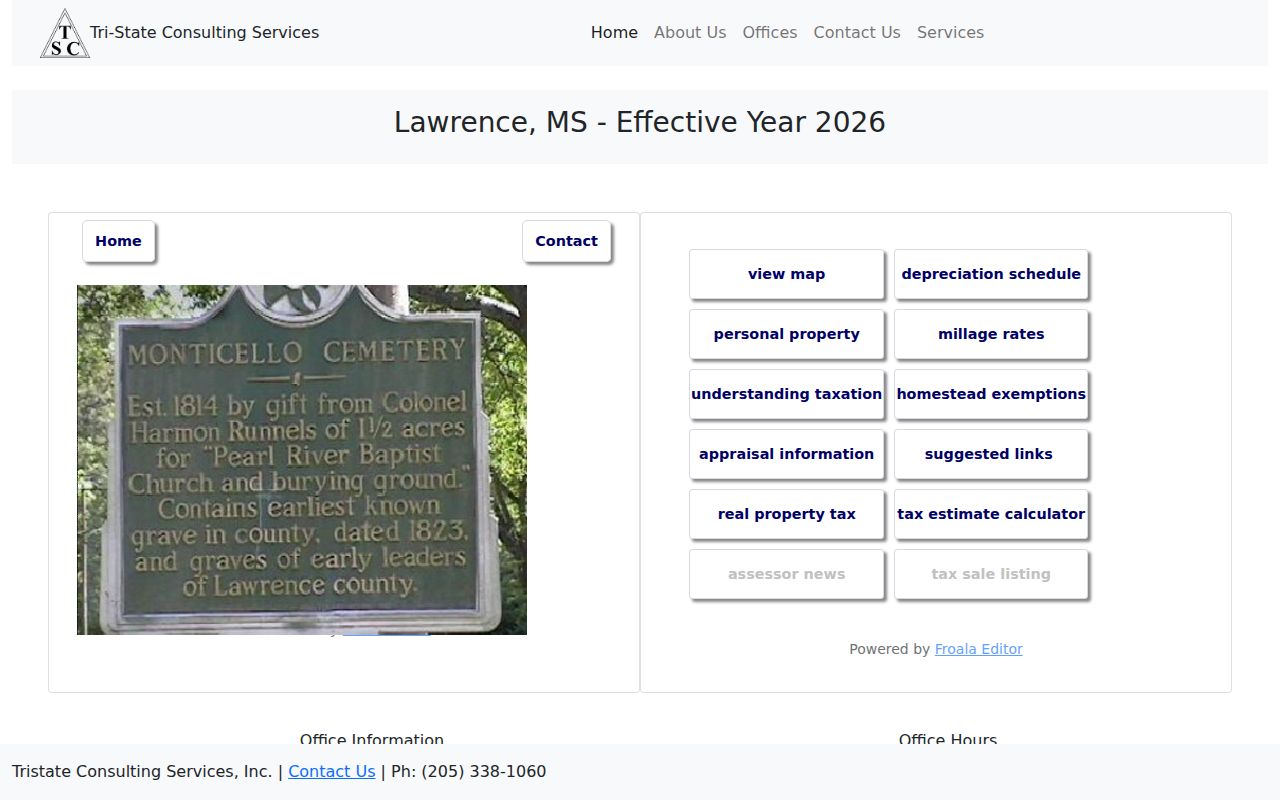
The county's links send a tax question to the right tool instead of blending appraisal, bill, and estimate together.
The assessor search accepts owner, address, PPIN, and PARID. Save both keys. Their relationship is not explained anywhere in the results. Each result row also lists deed book and page, which helps when a roll owner conflicts with a later deed record.
Find a Lawrence County Tax Bill
The Lawrence County collector page has not been reachable, so no live bill or receipt interface is available to consult. Start with the appraisal search instead. Then ask the Lawrence County Tax Assessor/Collector directly for the bill, receipt or payment status, delinquency or redemption standing, and the applicable millage for the years in question.
Any bill or receipt figure deserves confirmation from the collector. Nothing should be inferred from an interface the office does not currently publish.
- Search the appraisal form by address, owner, PPIN, or PARID and record the exact matching row.
- Choose the tax year and ask the collector for the actual bill and payment or receipt status.
- Confirm the assessment class, value, and any homestead treatment with the assessor.
- For delinquency, ask for the current sale, redemption, and notice status rather than relying on an old list.
- Assessed value
- The class-adjusted value used in the tax calculation.
- Millage
- The rate applied per thousand dollars of assessed value.
- Homestead exemption
- Tax relief for an eligible owner-occupied home under stated rules.
- Tax lien
- A claim tied to unpaid tax, distinct from a deed transfer.
Note: When no bill portal is available, a direct collector response remains the dependable source for payment, delinquency, sale, and redemption facts.
A written request keeps the reply precise. Ask for the bill, receipt or payment status, delinquency and redemption standing. Also request the applicable millage for the stated PPIN or PARID and years. Include the owner and address shown in appraisal. But treat the parcel key as the main search clue. Ask whether any copying or research charge must be paid before production, too.
Estimate Lawrence County Taxes
The Lawrence tax estimator takes a district and a fair-market value. It then runs three scenarios at once. It models Regular Homestead, Special Homestead, and Without Homestead outcomes for the same parcel number. That side-by-side view helps when you are testing what an exemption might save. Remember its limits. An estimate is not a tax bill. It proves nothing about payment history or a recorded sale price. See the official district selector and fair-market-value input before running your own numbers.
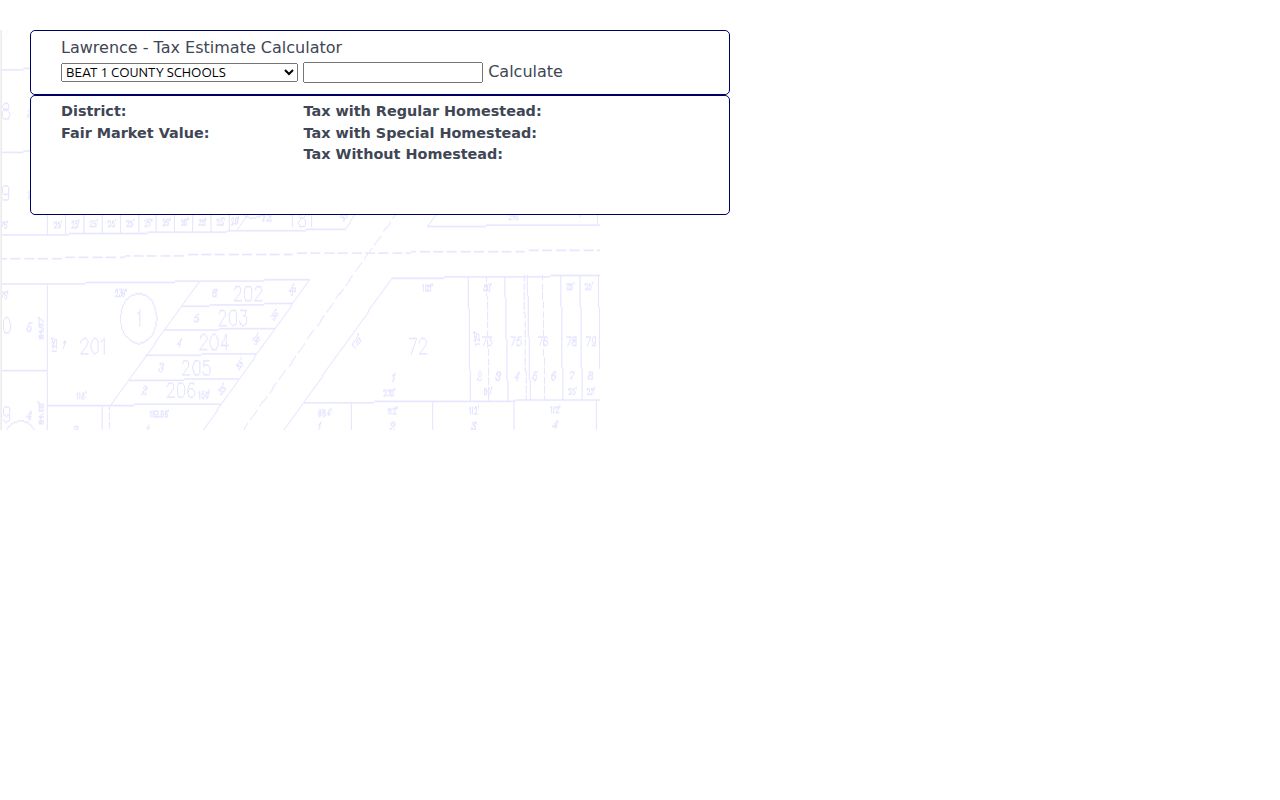
The estimator's own inputs explain why the selected district belongs in your notes alongside any estimate.
Run the formula in order. True value times the class ratio equals assessed value, and assessed value times millage gives tax before credits or other treatment. Label every calculator output as an estimate.
Lawrence Millage by Beat
Millage in Lawrence County shifts by beat. The official millage table breaks every combination apart. It covers the county levy, school district shares, the state portion, and municipal add-ons for Beat 1 Monticello, Beat 4 New Hebron, and Beat 5 Silver Creek. County-school blends and state-tax-only variants appear there too. Two neighboring parcels can land under different rates. Matching values will not mean matching tax bills when the beats differ. Check the plat or GIS map first. Review the official county, city, and school millage combinations.
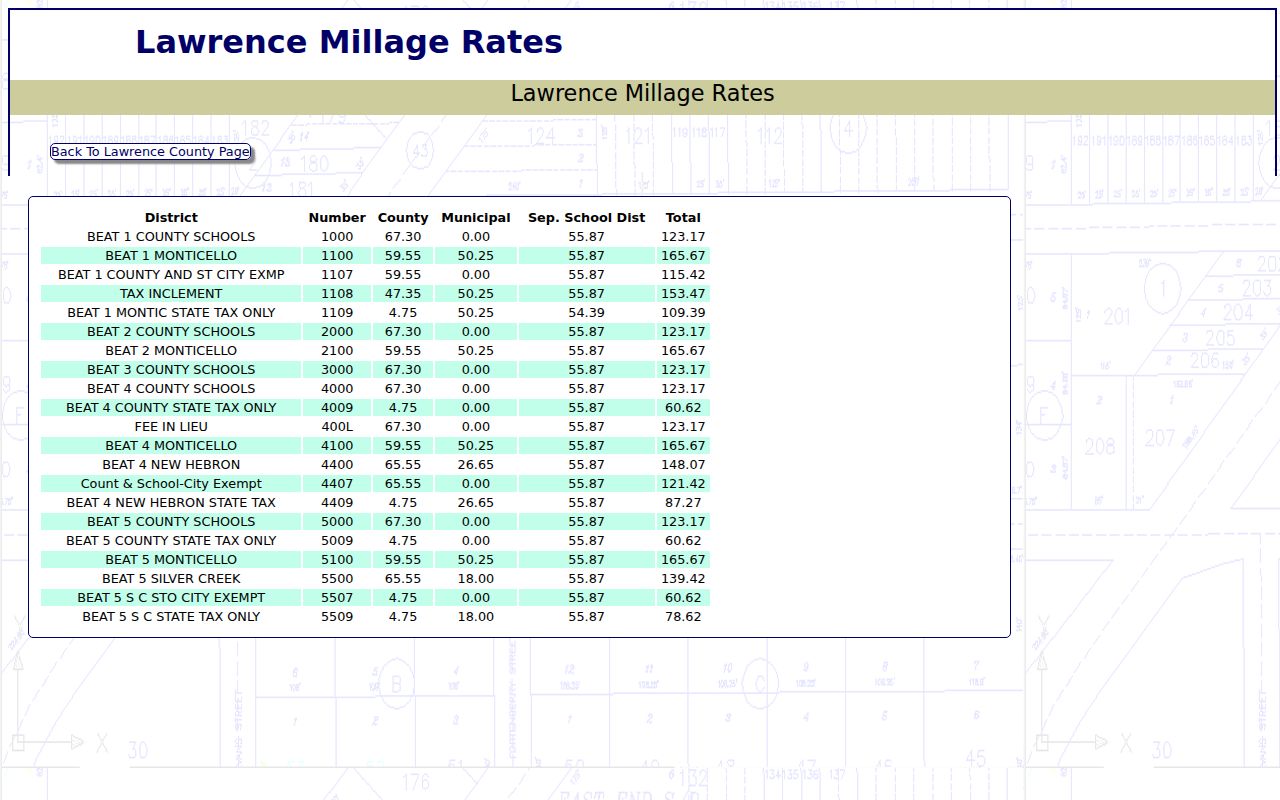
A district or beat is essential when checking any tax difference.
A mailing city or ZIP does not establish the taxing district. Use parcel geography and the official assignment, especially outside compact town limits.
Read each component, not just the total. County, school, municipal, and state-tax parts can combine differently across published rows. Two nearby tracts can produce different estimates. Compare their beat and every component. Do this before questioning the appraisal. A district boundary can explain the whole gap. This stays true even when both parcels share a postal city. The same assessed value does not change that.
Lawrence Homestead Filing Rules
The published homestead page states a January 2 through April 1 filing window. It distinguishes regular and special homestead treatment and lists eligibility and document guidance. The office should confirm current qualification for a specific parcel.
Read the county-linked homestead timing and eligibility material.
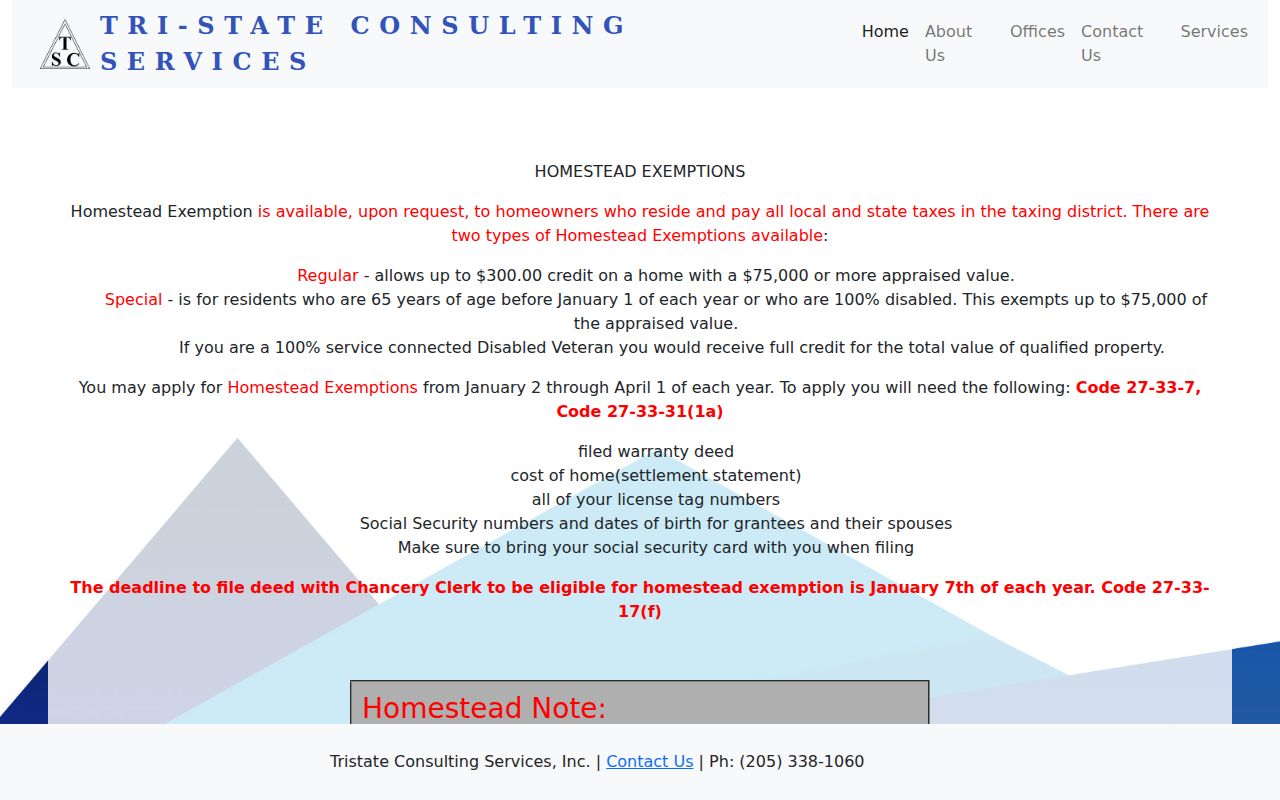
Homestead treatment changes the tax outcome without touching the tract's true or assessed value. That distinction matters when comparing estimates. Keep value, ratio, millage, district, exemption, and credit in separate columns. That way the effect of the filing stands out. The filing window runs January 2 through April 1. An application inside that window may affect a later record. But the published material does not establish the exact posting date for one account.
Ask which roll or bill will show an approved filing. Keep any receipt or written decision. The county's material separates regular homestead treatment from special homestead treatment. It also lists the documents each filing wants. Eligibility still turns on the applicant and the home. The assessor, not a website, confirms it. A calculator choice labeled Special Homestead is only a model. It does not establish that the assessor approved that treatment for the parcel. Save the filing date, the documents submitted, and the office response. If a credit differs from the estimate, compare the approved status and district first. Then leave the market-value input alone until the discrepancy is explained.
January 1 Lawrence Roll Owner
Mississippi assesses property to the January 1 owner of record. A deed recorded later may surface in Chancery land records. The assessment roll may catch up afterward. When they disagree, request the deed recording date. Ask how the assessor treats it on the next roll. The roll owner answers one question only. A party responsible under a private closing agreement may differ from the roll. The name on a later tax bill may differ as well. Either can still be correct. Public assessment entries do not settle a private allocation between parties. Value terms are defined in the Lawrence County property value explanation.
Contest a Lawrence County Assessment
Mississippi Department of Revenue guidance assigns valuation to the county assessor and sends objections to the land roll before the county board of supervisors. The county publishes no Lawrence-specific appeal form, date, or hearing schedule. Ask the assessor for the current procedure. Strong evidence helps. Bring the parcel record, the disputed field, photos, a survey, comparable sales, and any documents showing an error in class, acreage, improvements, or exemption status. Keep the appeal about value or classification. Payment status and a private sale estimate are separate questions.
Confirm the window. Ask the assessor for the current objection deadline, required filing method, and Board of Supervisors hearing process.
A fiscal-year 2027 courthouse repair appropriation could affect access. Confirm the office location before an in-person assessment visit. Also confirm public hours, counter procedure, and copy route.
Delinquent-tax research needs the same date discipline. MDAH Series 2050 holds an 1851 delinquent lot list and tax orders from the 1850s. Those items are historical evidence rather than a current delinquency list. Current sale and redemption questions belong with the collector. The documented foreclosure workflow uses courthouse posting plus publication in The Lawrence County Press. Verify the live notice, parcel, owner, deadline, and sale status before drawing any conclusion.
The LTAMS source adds a south-front-door sale location and a courthouse bulletin-board notice. The Lawrence County Press is a Wednesday paper. Its submission deadline is Thursday at 5 p.m. Those details frame a newspaper search window. They do not prove a parcel is scheduled for sale, though. Ask the collector or clerk for the live proceeding record.